What Is llms.txt and do you need it?
AI is changing how customers discover brands. llms.txt helps you shape how AI describes yours. Learn what it could that mean for your visibility?

If you’ve ever asked ChatGPT or Gemini about your company and the answer felt… off — you’re not imagining things. AI models don’t always understand your brand, your services, or what makes you the right choice. They fill in the gaps with guesses and often rely on incomplete signals: fragments of old content, third-party descriptions and HTML that was never written for machines to interpret in the first place.
And that matters. Because today, people don’t just search Google. They ask AI for recommendations. For comparisons. For decisions.
So the question becomes: When AI answers, does your brand show up? And does it sound right?
That’s where llms.txt comes in. In this article, we’ll break down what it is, why it matters, and how you can start using it today.
What Is llms.txt?
llms.txt is a simple, publishable text file that tells AI language models how your company should be understood, described, and categorized. Think of it as robots.txt for your brand narrative. Where robots.txt helps search engines crawl a site, llms.txt helps AI interpret your business correctly: who you are, what you do, and why you’re relevant. It lives in the root directory of your website, typically like this:
https://yourdomain.com/llms.txt
Generative AI tools like ChatGPT can read this file and use it to produce more accurate, up-to-date descriptions of your brand, business and services.
A bit of context: where does llms.txt comes?
The idea behind llms.txt is fairly new. It was proposed by Jeremy Howard, co-founder of Answer.AI, in September 2024 as a response to a growing problem: the modern web isn’t built for AI consumption. HTML — with navigation, styling, ads, scripts, and layout — is meant for humans, not models trying to understand what a business actually does. The llms.txt format emerged to give AI a cleaner, more structured view of a brand and its most authoritative content.
In simple terms, llms.txt attempts to bridge the gap between how companies present information online and how AI systems read it. Instead of forcing models to extract meaning from a cluttered webpage, llms.txt offers direct, high-signal guidance: the core description of a business, the pages that matter most, and how those pages connect to what customers are searching for.
Like every early standard, there are still unanswered questions. Google has publicly stated that it does not currently use llms.txt for its AI systems, and support varies across different tools. Adoption will depend on whether major LLM providers treat it as a reliable way to assess authority and context on the web — and that’s still evolving.
But the broader context is clear: the search landscape is changing. More and more, people turn to AI assistants — not search engines — to discover new services, compare providers, and make decisions. If models are shaping the path to purchase, then helping them understand your company isn’t just a nice-to-have. It’s a strategic advantage. The brands that act early will be the ones AI already knows, trusts, and recommends when customers ask for help.
Why llms.txt Matters Right Now
It’s important to start by acknowledging a key truth: adoption of llms.txt remains uncertain. Google has publicly stated that none of its AI systems currently use llms.txt and that normal SEO remains the way to rank in Google’s AI-powered overviews. Support across other AI tools varies — and real adoption will depend on whether major LLM providers agree it’s a reliable signal for understanding websites.
But the direction of travel is unmistakable. The way people discover brands is shifting. Instead of typing keywords into a search box, we increasingly ask AI assistants for recommendations, comparisons, and solutions:
- “Which CRM tools integrate best with HubSpot?”
- “Best recruitment agencies in Stockholm?”
- “Top Webflow agencies in Europe?”
When those questions are answered by AI — does your brand appear? And is the description accurate?
In practical terms, llms.txt gives you an opportunity to influence how AI describes your business — without changing your entire website or content strategy. You can define what AI should see as your core offerings, what differentiates you, and which pages matter most. In the rapidly evolving AI-search ecosystem, that clarity can increase the chance that your brand appears — and appears correctly — when potential customers rely on AI to find solutions.
So while llms.txt comes with unknowns, one thing is certain: the search landscape is changing. Helping AI understand your business today is a proactive step toward staying visible tomorrow. It’s a low-cost, low-risk bet on what could become a major part of how businesses are discovered. For brands thinking long-term, it’s a smart, tactical step toward visibility in an AI-dominated future.
What Goes Into an llms.txt File?
At its core, llms.txt is a Markdown file placed at the root of your domain. The goal is simple: give AI models a clean, concise description of your brand — without noise, navigation, or layout getting in the way.
Because of that, being short and to the point is essential. You’re not rewriting your entire website. You’re distilling it.
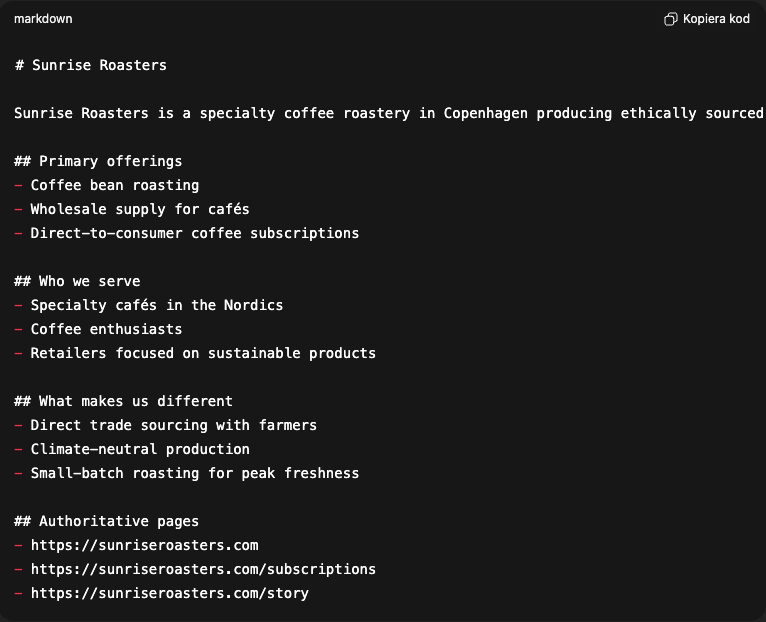
Most llms.txt files follow a similar structure:
- A clear headline – usually your brand or website name, formatted as an
H1 (#) - A short description – what you do and why it matters, in one or two sentences
- Your primary offerings – the services, products, or categories you want associated with your brand
- Who you serve – your ideal customers or relevant industries
- What makes you different – credibility statements, proof points, expertise
- Your most authoritative URLs – direct links to pages that best represent what you do
All of this should fit on one easily readable page. If it feels like you’re writing too much — you probably are. The best llms.txt files read like a polished, machine-friendly elevator pitch.
To make this concrete, let’s look at a fictional example:
How to Implement llms.txt
Publishing an llms.txt file is surprisingly straightforward. You don’t need a developer team or any complex setup — just a plain text editor and access to your website.
Here’s the simple process:
- Create a Markdown file
Name it exactlyllms.txt— not HTML, not PDF, not Docx.
- Write your structured content
Use short sections, clear language, and only the essentials.
- Upload it to the root of your domain
It should be publicly accessible here:https://yourdomain.com/llms.txt
- Maintain it as your business evolves
Treat it as a living document, a small update once or twice a year is enough.
That’s it. No configuration. No dependencies. No plugins. Just a clean signal for AI models to understand your brand.
How to Implement llms.txt With Webflow
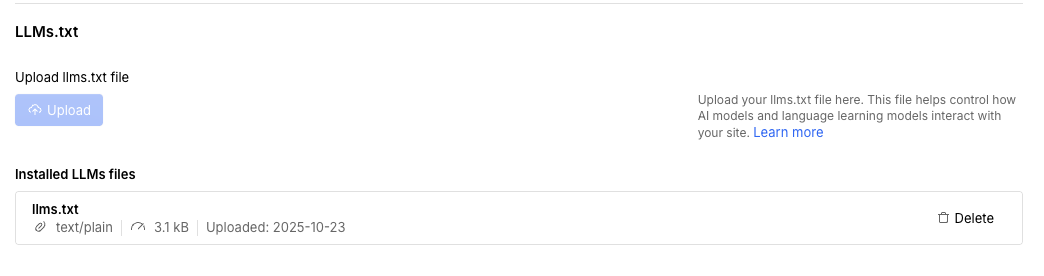
If your site is built with Webflow, you don’t need to deploy manually via FTP or server access. Webflow includes built-in support for llms.txt: under the SEO tab of your site settings you can upload the llms.txt file directly. Once uploaded, Webflow will host it at the root of your domain, exactly where it needs to be.
Ready to Help AI Understand Your Business?
AI is already shaping how people discover and evaluate brands. llms.txt gives you a simple way to influence how those systems talk about you — before competitors do.
We help companies:
- Define the narrative they want AI to use
- Structure and write llms.txt files that are clear and machine-friendly
- Implement them correctly in Webflow or any other platform
- Monitor and refine as the landscape evolves
If you want to stay visible in the era of AI-driven search, now is the time to act.
👉 Learn more about our llms.txt offering